Which AI Book Should You Read First?
-
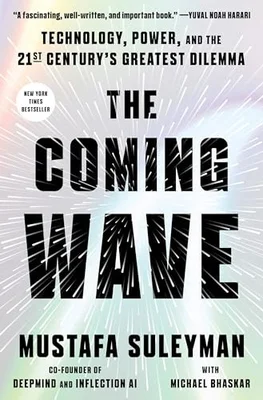 Governance and containment The Coming Wave Suleyman frames AI containment as the 21st-century challenge; the DeepMind co-founder is now CEO of Microsoft AI.
 -
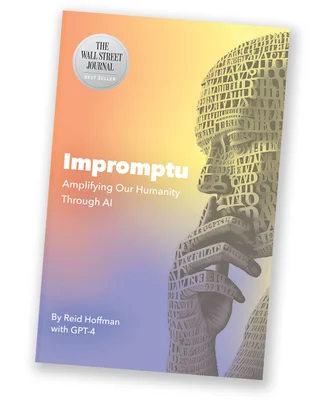
First book written with GPT-4 Impromptu A GPT-4-era artifact in print: Hoffman drafted the manuscript with the model itself in the week of its launch.
-
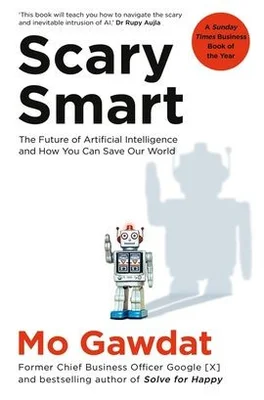
Risk frame, non-technical Scary Smart Mo Gawdat's parenting-AI framing translates Google X experience into accessible language for readers without a technical background.
The 9 AI Books by Tech Executives Compared
| Title | Goodreads | Best For | Pages |
|---|---|---|---|
| 01The Coming Wave (2023) | 3.79 | Governance and containment | 352 |
| 02AI Superpowers (2018) | 4.09 | China-US AI race | 272 |
| 03Genesis (2024) | 3.52 | Statecraft frame | 288 |
| 04Superagency (2025) | 3.33 | Optimist counterpoint | 288 |
| 05Impromptu (2023) | 3.79 | First book written with GPT-4 | 280 |
| 06The Singularity Is Nearer (2024) | 3.82 | Acceleration thesis | 432 |
| 07Scary Smart (2021) | 3.81 | Risk frame, non-technical | 320 |
| 08AI 2041 (2021) | 3.82 | Scenario fiction | 480 |
| 09What Is ChatGPT Doing (2023) | 3.86 | Technical explainer | 102 |
At a glance: 9 AI books by tech executives spanning Goodreads 3.33 to 4.09 across 102 to 480 pages, ranked by editorial weight not crowd score.
How We Chose
Aiifi reviewed 11 AI books authored by current or former tech executives published from 2018 onward, scoring each against five knockout criteria before ranking the 9 that passed. From 11 candidates surfaced via competitor-citation analysis and editorial-list cross-reference, 9 cleared all five knockouts. For broader reading lists, see Aiifi's other AI book listicles.
- Tech-executive authorship: author held a named operator role at a frontier AI lab, Big Tech firm, or technology division.
- Topic centrality: AI is the book's central subject, not one chapter inside a broader memoir or strategy text.
- Recency: published from 2018 onward, with weight given to post-November 2022 titles that engage with the LLM era.
- Quality signal: Goodreads aggregate score, New York Times bestseller or Wall Street Journal bestseller status, or a Financial Times Business Book of the Year listing.
- Audience fit: written for non-technical white-collar readers, not for ML researchers or engineering teams.
Several picks pass on bestseller or award status rather than the Goodreads 4.0 threshold; sourcing also drew on McKinsey's mid-2025 standout-AI-books list. Excluded titles are in Also Considered. Editorially independent.
Which AI Books Carry the Strongest Operator Authority?
The Coming Wave, AI Superpowers, and Genesis lead by editorial weight, not crowd score: Suleyman's active Microsoft AI seat, Lee's three-decade US-China credential, and the posthumous Kissinger-Schmidt-Mundie statecraft pairing. All three books were authored by people who built or led the AI labs they critique, giving each the inside-the-room authority that journalist and academic coverage cannot match.
1. The Coming Wave: Technology, Power, and the Twenty-first Century's Greatest Dilemma (2023)
What it's about
The Coming Wave argues AI containment is the defining 21st-century challenge, authored by Mustafa Suleyman — DeepMind co-founder, now Microsoft AI CEO since March 2024. Suleyman pairs AI with synthetic biology, gene editing, and quantum computing as one wave, then names a 10-step containment agenda spanning audits, choke points, treaties, and a culture shift across labs. The Guardian published a long-form 2023 interview tracking the thesis.
Pros
- Mustafa Suleyman co-founded DeepMind (2010), Inflection AI (2022); took Microsoft AI CEO seat March 2024 per CNBC.
- Shortlisted for the 2023 FT-Schroders Business Book of the Year per the official announcement.
- Bill Gates reviewed it on GatesNotes, recommending it as an AI entry-point read.
Cons
- 352 pages pivot heavily into synthetic biology, gene editing, and quantum computing — a stretch for AI-only readers.
- The 10-step containment agenda reads as a manifesto, not a working playbook policy teams can execute.
Aiifi's Take
Pick The Coming Wave over Genesis when active-operator authority matters more than statecraft-chair pedigree: Suleyman, now Microsoft AI CEO (since March 2024), wrote the book at Inflection AI after co-founding DeepMind, while Genesis arrives posthumously from Henry Kissinger with Schmidt and Mundie carrying the AI half. Crown Publishing's descriptor positions the book as coming from "a co-founder of the pioneering artificial intelligence company DeepMind and current CEO of Microsoft AI" — a vantage no other 2023-era AI book on this list can match. The Coming Wave anchors our AI books for leadership readers shortlist.
Bottom Line
Read The Coming Wave if AI governance and containment is the angle that lands hardest for your work.
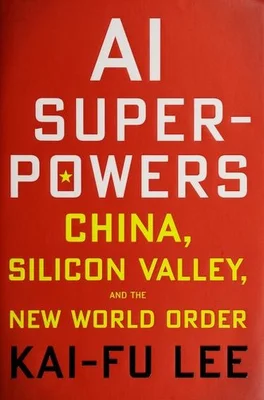
2. AI Superpowers: China, Silicon Valley, and the New World Order (2018)
What it's about
The 2018 edition of AI Superpowers argues China has closed the United States lead in applied AI through data scale, execution culture, and a more aggressive entrepreneurial cohort, written by Kai-Fu Lee (founder and CEO of Sinovation Ventures, former president of Google China). The book walks through the four waves of AI deployment, US and Chinese policy divergence, and a personal cancer-driven coda on human work.
Pros
- Kai-Fu Lee was Google China President (2005-2009), founded Sinovation Ventures (2009) — a China-side vantage no other author here matches.
- Goodreads 4.09 (16,916 ratings) plus NYT and WSJ bestseller status — the list's strongest platform signal.
Cons
- Published September 2018, pre-ChatGPT: deep learning, computer vision, autonomous driving examples now dated.
- The zero-sum US-versus-China framing and the overgeneralisation drawn from Chinese consumer-data scale have aged unevenly as the geopolitical picture has fragmented further since 2018 publication.
Aiifi's Take
Pick AI Superpowers over The Coming Wave when the China-US geopolitical thesis matters more than the global containment framework: Kai-Fu Lee writes from three decades inside the Beijing AI industry, while Suleyman, now Microsoft AI CEO, makes the governance case. Lee's 2018 thesis — that China's data scale and execution culture had closed the US lead in applied AI — was the synthesis the Financial Times engaged on release as both consensus and challenge. AI Superpowers leads our AI books for beginners shortlist as the geopolitical-foundation read.
Bottom Line
AI Superpowers is the right read for non-technical professionals who need the foundational China-US AI race text in one weekend.
3. Genesis: Artificial Intelligence, Hope, and the Human Spirit (2024)
What it's about
Henry Kissinger's Genesis pairs his statecraft authority with Schmidt-Mundie credentials, asking how heads of state and frontier labs should govern intelligence that exceeds human reasoning. Eric Schmidt (former CEO of Google) and Craig Mundie (former Chief Research and Strategy Officer of Microsoft, 2006-2012, and co-author of Genesis) cover security, prosperity, science, strategy, and human identity. LSE Review of Books and Kirkus Reviews both engaged the book at length. Genesis sits in our AI ethics books shortlist as the statecraft anchor.
Pros
- Co-authored by Eric Schmidt (Google CEO 2001-2011) and Craig Mundie (Microsoft CRSO 2006-2012) — credentials no 2024 AI book matches.
- Selected for McKinsey's July 2025 standout AI-and-tech books list by Knight Foundation CEO Maribel Pérez Wadsworth.
- Hit NYT, USA Today, and LA Times bestseller lists on the November 19, 2024 release per Hachette Book Group.
Cons
- 288-page statecraft survey moves fast across governance, prosperity, and existential risk — light on concrete operator mechanics.
- Kissinger died November 2023 pre-publication; the frontier-AI commentary reflects a pre-GPT-4o, pre-Claude-3.5 read.
Aiifi's Take
Pick Genesis over The Coming Wave when statecraft co-author authority and policy framing matter more than single-operator first-person voice and a working containment playbook: the three-author committee speaks to heads of state, while Suleyman writes for policy teams. Genesis carries the strongest editorial endorsement of any post-2024 AI book in this set, picked for the McKinsey & Company mid-2025 reading list by a sitting foundation chief.
Bottom Line
Genesis is the right read for policy and strategy professionals who need the statecraft framing from a Kissinger-Schmidt-Mundie trio rather than a single sitting CEO.
Which AI Books Help Executives Enter AI Strategy?
Superagency, Impromptu, and The Singularity Is Nearer translate operator experience into strategic frames executives can apply. Reid Hoffman wrote two of them: Impromptu was published March 15, 2023, one day after OpenAI released GPT-4, and Superagency reached the New York Times bestseller list in January 2025. Each book argues a distinct thesis about how AI rewrites professional work over the next ten years.
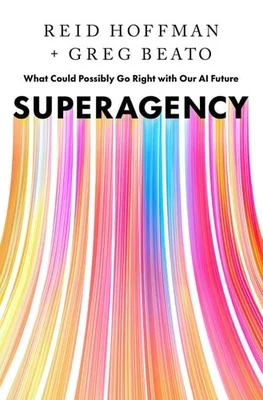
4. Superagency: What Could Possibly Go Right with Our AI Future (2025)
What it's about
Across 288 pages, Superagency argues that AI scales individual human capability rather than threatening it, written by Reid Hoffman (co-founder of LinkedIn and Inflection AI; Greylock Partner since 2009) with Greg Beato (American writer and journalist; Superagency co-author with Reid Hoffman). The book traces four prior tech transitions, the printing press through the internet, then maps the same expansion pattern onto knowledge work, education, and decision-making with AI as the next general-purpose tool.
Pros
- Reid Hoffman co-founded LinkedIn (2002), Inflection AI (2022); Greylock Partner since 2009, per Wikipedia.
- Instant NYT and USA Today bestseller on January 2025 release, per Simon & Schuster.
- 288 pages — shortest of Hoffman's two AI titles, framed for business and knowledge-worker readers.
Cons
- Goodreads 3.33 across 1,153 ratings — smallest crowd-signal sample on this list.
- Hoffman argues against AI-risk framing throughout — balanced risk-benefit readers will need a containment-frame companion.
Aiifi's Take
Pick Superagency over Impromptu when Hoffman's 2025 strategic synthesis of AI's effect on knowledge work matters more than the 2023 GPT-4 collaboration record that captured early frontier-model behaviour. Superagency reached the New York Times and USA Today bestseller lists immediately on its January 2025 launch, with Simon & Schuster acting as distribution publisher for Authors Equity — a release outcome Kirkus Reviews engaged within its editorial coverage. Superagency anchors our AI books for business shortlist for knowledge-work readers.
Bottom Line
Read Superagency if you want Hoffman's case for AI as agency multiplier without the AI-risk framing that anchors Suleyman and Gawdat.
5. Impromptu: Amplifying Our Humanity Through AI (2023)
What it's about
Impromptu is a 2023 dialogue book in which Reid Hoffman prompts GPT-4 across education, creativity, justice, and journalism, treating the model's responses as half the manuscript. The text reads as transcript plus commentary: Hoffman frames each prompt, GPT-4 answers verbatim, and Hoffman annotates what the exchange surfaces.
Pros
- Reid Hoffman co-founded LinkedIn (2002) and Inflection AI (2022), and has been a Greylock Partner since 2009 — investor-operator vantage no journalist or academic matches.
- Shipped March 15, 2023, 24 hours after OpenAI's GPT-4 release — first trade book co-authored with a frontier LLM.
- Prompt-by-prompt structure with Hoffman annotating each GPT-4 output makes the methodology auditable in a way other AI books are not.
Cons
- A 2023 artifact: GPT-4's behaviour and reasoning have moved substantially since March 2023; exchanges Hoffman cites are snapshots.
- Self-published via Dallepedia LLC at 280 pages; chapters read as standalone dialogues, not a developing thesis.
Aiifi's Take
Pick Impromptu over Superagency when the GPT-4-era artifact and human-AI co-authorship record matter more than current frontier-model synthesis: Impromptu shipped with GPT-4 as a literal co-author 24 hours after the model's launch, while Superagency (2025) carries Hoffman's present-tense strategic argument for business readers. Hoffman documents the pre-public-launch beta drafting process directly on Greylock — the rare frontier-AI book whose source is the author's own investor home page.
Bottom Line
Read Impromptu if you want the historical record of how GPT-4 actually behaved in launch week, not a current strategic synthesis. Pairs with our ChatGPT books roundup for launch-era context.
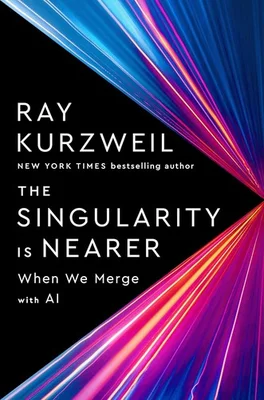
6. The Singularity Is Nearer: When We Merge with AI (2024)
What it's about
The 2024 update of The Singularity Is Nearer extends Kurzweil's 2005 forecast that machine intelligence will match human intelligence by 2029 and merge with it by 2045, written by Ray Kurzweil (inventor and futurist; Director of Engineering for AI at Google from 2012 to 2025; National Medal of Technology and Innovation recipient, 1999). The book updates the original Singularity Is Near with chapters on longevity, brain-computer interfaces, and post-GPT-4 capability curves.
Pros
- Ray Kurzweil served as Google's Director of Engineering for AI from 2012 to 2025, per Wikipedia.
- Landed as instant NYT bestseller on June 2024 publication per Penguin Random House.
- Holds the U.S. National Medal of Technology and Innovation (1999) — anchors a decades-long predictions track record.
Cons
- 432 pages stretch across longevity, nanotechnology, and brain-computer interfaces — adjacent transhumanism pulls focus from the LLM argument.
- The 2029 and 2045 dates restate Kurzweil's 2005 predictions, not fresh post-GPT-4 calibrations — a continuity volume.
Aiifi's Take
Pick The Singularity Is Nearer over AI Superpowers when an acceleration-timeline thesis from a Google AI engineering insider matters more than the geopolitical race framing: Kurzweil writes from the technology-curve seat, Lee from the policy-and-capital seat. Kurzweil argues human-AI merger arrives within decades and frames 2029 as the human-level AI threshold, per Penguin Random House's publisher-of-record description — calendar specificity readers should treat as Kurzweil's exposure thresholds, not industry consensus. Kurzweil's job-displacement thesis extended: see when will AI take my job.
Bottom Line
The Singularity Is Nearer is the right read for professionals who want Kurzweil's acceleration thesis from the technology-curve seat rather than the geopolitics-first one.
Which AI Books Work Best for Non-Technical Readers?
Scary Smart by Mo Gawdat, AI 2041 by Kai-Fu Lee and Chen Qiufan, and Stephen Wolfram's ChatGPT explainer pair operator credentials with accessible framings for non-technical readers. Gawdat ran Google X as Chief Business Officer; Lee chose narrative fiction to update his 2018 thesis; Wolfram has run his eponymous research firm as CEO for 39 years. Each book translates frontier-lab work into formats general readers can finish in a weekend.
7. Scary Smart: The Future of Artificial Intelligence and How You Can Save Our World (2021)
What it's about
Mo Gawdat's Scary Smart argues ordinary readers shape AI more than policymakers do, drawing on his tenure as former Chief Business Officer of Google X (see Wikipedia for his role history). Gawdat frames AI as a child learning from collective human behaviour online, then asks readers to treat every post, prompt, and search as a parenting moment. The book covers his Google X tenure, his son's death, and a personal ethical reckoning.
Pros
- Mo Gawdat was Chief Business Officer at Google X (2013-2018) — inside the moonshot projects that became frontier-AI work.
- Gawdat's 2025 CNBC interview called the idea AI creates new jobs "100% crap".
Cons
- Goodreads 3.81 across ~3,300 ratings — critics flag the parenting-AI metaphor as more emotional than analytical.
- Published September 2021, pre-ChatGPT — readers wanting direct engagement with GPT-4 or Claude get a pre-LLM threat-model framing.
Aiifi's Take
Pick Scary Smart over Genesis when a Google X operator's emotional framing on AI risk lands harder than statecraft policy framing: Mo Gawdat writes as a parent and ex-Google insider asking ordinary readers to take responsibility, while Genesis addresses heads of state. Gawdat's 2025 CNBC interview calling the idea AI creates new jobs “100% crap” extends the public-discourse arc that began with Scary Smart's 2021 thesis on AI displacement. Pairs with our AI ethics book picks for the threat-thesis branch.
Bottom Line
Scary Smart is the right read if AI risk feels more like a parenting question than a policy one.
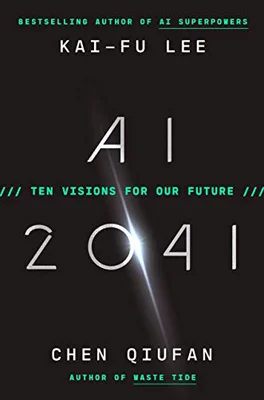
8. AI 2041: Ten Visions for Our Future (2021)
What it's about
Across 480 pages, AI 2041 pairs ten short stories set in 2041 with Kai-Fu Lee's technology commentary on each, co-authored with Chen Qiufan (Chinese science-fiction novelist and co-author of AI 2041). Each vignette dramatises one trajectory, autonomous weapons, deepfakes, education AI, mixed-reality entertainment, contactless love, then Lee unpacks what is plausible versus speculative. Los Angeles Review of Books and Locus Magazine both engaged the book on release.
Pros
- Named Best Book of 2021 by Wall Street Journal, Washington Post, and Financial Times.
- Kai-Fu Lee (ex-Google China president, Sinovation Ventures) pairs with novelist Chen Qiufan, who wrote the ten scenarios.
- Global Policy Journal's 2022 academic review treats it as a serious policy artifact.
Cons
- 480 pages — longest title here, ~40% fiction and ~60% Lee commentary; neither a clean argument nor a clean novel.
- The 2021 horizon predates November 2022's LLM moment — foundation-model regulation, agentic systems, and post-training alignment sit outside the frame.
Aiifi's Take
Pick AI 2041 over AI Superpowers when scenario fiction is the format that engages the reader: each of the ten 2041 vignettes is a concrete situation readers can react to, while AI Superpowers asks readers to accept a single argument-driven thesis. AI 2041 swept Wall Street Journal, Washington Post, and Financial Times Best-Book-of-the-Year selections on its 2021 release per the Penguin Random House page — an editorial outcome the 2018 AI Superpowers did not match.
Bottom Line
Where AI Superpowers compresses, AI 2041 hands readers ten concrete 2041 vignettes to react to. Lee's scenario method extends into our AI marketing books roundup.
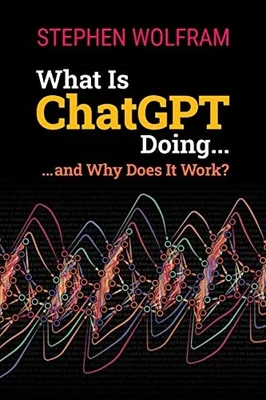
9. What Is ChatGPT Doing and Why Does It Work? (2023)
What it's about
What Is ChatGPT Doing explains next-token prediction, embedding-space geometry, attention, and reinforcement learning from human feedback in 102 pages, written by Stephen Wolfram (founder and CEO of Wolfram Research since 1987). The book is a print version of Stephen Wolfram's original February 2023 essay, with diagrams and a glossary added for trade-book readers.
Pros
- Stephen Wolfram founded Wolfram Research in 1987 and remains CEO 39 years on per Wikipedia.
- Republishes Wolfram's February 14, 2023 long-form essay, posted eleven weeks after ChatGPT's public launch.
- 102 pages — shortest book on this list, a single-sitting walk from softmax through attention to fine-tuning.
Cons
- Goodreads 3.86 across ~1,500 ratings — thinnest crowd-signal in this list and just below the methodology's 4.0 quality floor.
- Middle chapters move quickly through embeddings, attention, and RLHF — readers without neural-network vocabulary will slow down or skim.
Aiifi's Take
Pick What Is ChatGPT Doing over Scary Smart when readers want the mechanism answer — how the model actually works — rather than the ethical framing: Wolfram answers next-token prediction and embedding-space geometry, while Gawdat's Scary Smart pitches the emotional reckoning for the same non-technical audience. Wolfram reprinted his blog post eleven weeks after ChatGPT's launch, making this the only book on the list whose primary source is the author's own active research blog.
Bottom Line
What Is ChatGPT Doing is the right read for non-technical readers who want the mechanism answer in one sitting, and see our ChatGPT book roundup for adjacent titles.
Which AI Books Did We Consider but Not Include?
Hit Refresh and The Age of AI appear regularly on adjacent reading lists. Each was reviewed against the five criteria above and excluded for a specific reason, listed here so readers can decide whether the exclusion fits their needs.
- Hit Refresh: The Quest to Rediscover Microsoft's Soul and Imagine a Better Future for Everyone by Satya Nadella (2017): Topic-centrality knockout: Hit Refresh is Satya Nadella's 2017 Microsoft turnaround memoir; AI sits as one chapter inside a broader cloud-and-culture leadership argument. Strong tech-executive credential, but not a dedicated AI book.
- The Age of AI: And Our Human Future by Henry A. Kissinger, Eric Schmidt, Daniel Huttenlocher (2021): Superseded-by-pick knockout: The Age of AI is the 2021 Kissinger-Schmidt predecessor to Genesis (2024). The newer collaboration adds Craig Mundie and stronger editorial reception, so this list includes only one Kissinger-Schmidt entry.
- Trailblazer: The Power of Business as the Greatest Platform for Change by Marc Benioff (2019): Topic-centrality knockout: Trailblazer is Marc Benioff's Salesforce values-and-CRM manifesto with Einstein AI surfacing only as one platform example. Strong tech-executive credential, but the book is not a dedicated AI argument.
- Good Power: Leading Positive Change in Our Lives, Work, and World by Ginni Rometty (2023): Topic-centrality knockout: Good Power is former IBM CEO Ginni Rometty's leadership memoir; Watson and the IBM AI strategy appear in passing rather than as the book's thesis. Frontier-AI-executive credential without an AI-dedicated argument.
- Tools and Weapons: The Promise and the Peril of the Digital Age by Brad Smith and Carol Ann Browne (2019): Topic-centrality knockout: Microsoft President Brad Smith's tech-policy book covers AI as one thread alongside encryption, privacy, election integrity, and cyberwar. Frontier-tech-executive author, but AI is not the book's organising thesis.
- The Worlds I See: Curiosity, Exploration, and Discovery at the Dawn of AI by Fei-Fei Li (2023): Audience-fit knockout: Fei-Fei Li's memoir frames AI through her personal Stanford-to-Google-Cloud research arc rather than the strategy and containment lens this list locks. Strong frontier-AI-executive credential, but the genre is autobiography.
- Brave New Words: How AI Will Revolutionize Education (and Why That's a Good Thing) by Salman Khan (2024): Audience-fit knockout: Khan Academy founder Sal Khan's book focuses narrowly on AI in K-12 and higher education rather than the general AI-leadership frame this list locks. Tech-executive credential, but education-vertical scope.
- The Second Machine Age: Work, Progress, and Prosperity in a Time of Brilliant Technologies by Erik Brynjolfsson and Andrew McAfee (2014): Authorship-gate knockout: Brynjolfsson and McAfee are MIT economists rather than operating tech executives. Foundational AI-economics text, but the list privileges authorship from inside frontier-AI organisations.
- Power and Prediction: The Disruptive Economics of Artificial Intelligence by Ajay Agrawal, Joshua Gans, and Avi Goldfarb (2022): Authorship-gate knockout: Agrawal, Gans, and Goldfarb are University of Toronto economists rather than frontier-AI operators. Rigorous AI-economics framework, but authorship sits outside the operator-CEO lens this list locks.
Frequently Asked Questions
Which AI book by a tech executive should I read first?
Start with The Coming Wave by Mustafa Suleyman, CEO of Microsoft AI since March 2024 and co-founder of DeepMind. The book was shortlisted for the 2023 Financial Times Business Book of the Year and frames AI containment as the central 21st-century challenge, written for non-technical business and policy readers.
What makes a tech executive's AI book different from an academic's?
Tech-executive authors bring operator vantages from inside the labs and statecraft they describe: Suleyman ran DeepMind and now Microsoft AI, Schmidt ran Google, Hoffman co-founded Inflection AI. Academics analyse the field from the outside. Operator books surface trade-offs, internal debates, and incentive structures that external research cannot capture without direct labour and equity exposure.
How does AI Superpowers (2018) hold up against newer China-US AI books?
AI Superpowers remains the foundational China-US AI text, with 16,916 Goodreads ratings averaging 4.09 and a New York Times bestseller seal. The pre-LLM publication date is a real limitation that the 2021 follow-up AI 2041 partially addresses through scenario fiction. Read both: AI Superpowers for the geopolitical argument, AI 2041 for the post-2021 scenarios.
Which AI book by a tech executive is best for business leaders?
Reid Hoffman's Superagency, an instant New York Times and USA Today bestseller published in January 2025, was written explicitly for business and knowledge-worker audiences. For broader leadership framing, see Aiifi's best AI books for leaders and best AI books for business lists, which cover non-executive-authored titles as well.
Which is the newest AI book by a tech executive?
Reid Hoffman's Superagency, published January 2025, is the most recent in this list. Genesis followed in November 2024 and The Singularity Is Nearer in June 2024. All three were authored or co-authored by people holding active operator roles at the time of writing, which dates the arguments to a specific stage of the AI build-out.
Are any of these AI books co-written with the AI itself?
Yes. Reid Hoffman's Impromptu, published March 15, 2023, one day after OpenAI released GPT-4, is the first commercially-published book written in collaboration with GPT-4. Hoffman prompts the model throughout and treats its responses as text, making the book both a product of and a record of early frontier-model behaviour.